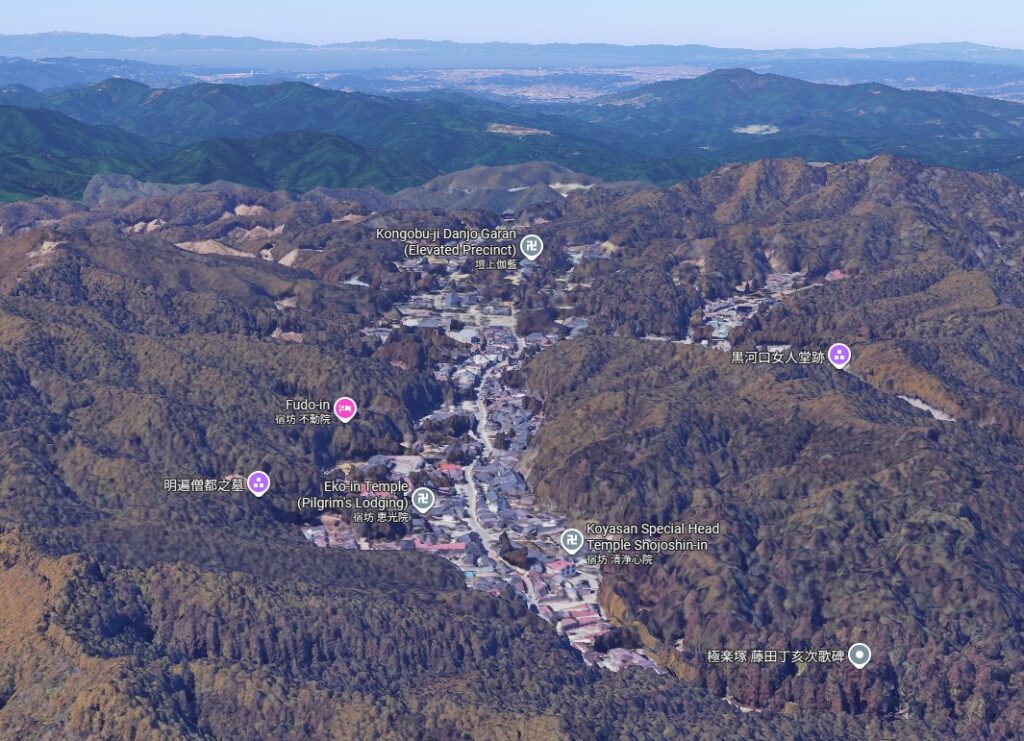
Located in Wakayama Prefecture, 100 kilometers south of Osaka, Mount Koya is a major site of Buddhist pilgrimage. It was founded over 1,200 years ago as a center for teaching esoteric Buddhism shingon by the monk Kukai, known as Kobo Daishi. There is no mountain called Koya. It is a plateau surrounded by eight peaks approximately 900 meters above sea level. Mount Koya, where there are 117 active Buddhist temples, has 2,500 inhabitants, a third of whom are monks. It is the largest religious city in the country. If you want to fully experience a religious and spiritual retreat that is difficult to practice elsewhere, it is a must-visit. Listed as a UNESCO World Heritage Site in 2004, pilgrims continually visit it for devotion to Kukai. Feel the Buddhist spirit spun continuously over many years in a majestic and mystical atmosphere.
Mount Koya is full of pretty points of interest, among which Okuno-in and Danjo Garan are the two great holy places to visit.
Okuno-in
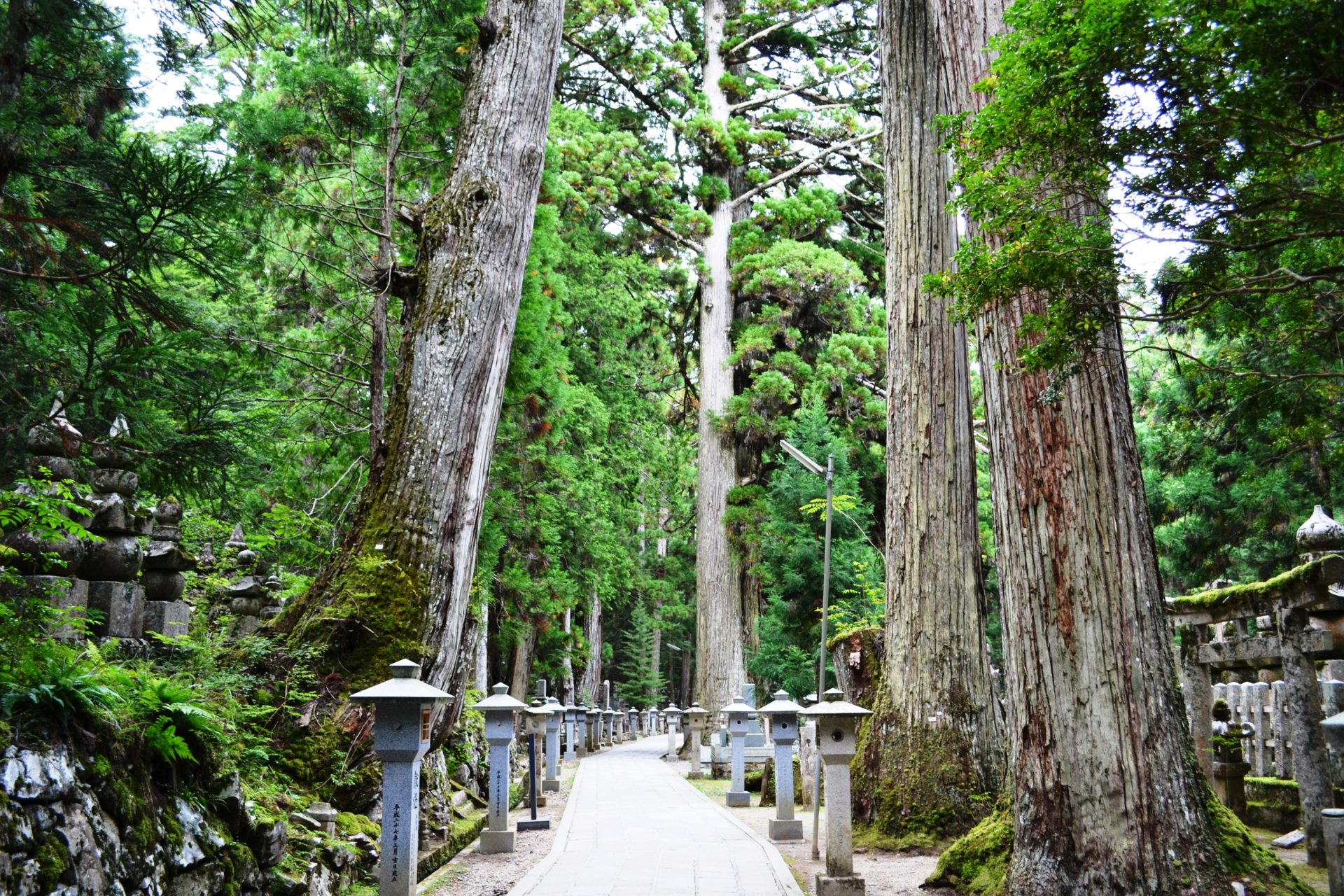
The heart of the visit to Mount Koya lies in the walk to Okuno-in which covers a large part of the east. Okuno-in is a necropolis that stretches 2 kilometers long from Ichi-no-hashi Bridge to Kukai Mausoleum. More than 200,000 tombstones and pagodas from different eras are lined up between the immense old cedars. The rustling of the wind in the branches, the light filtering between the branches, the tombstones covered in moss… The serene and mystical atmosphere that reigns there will captivate you.
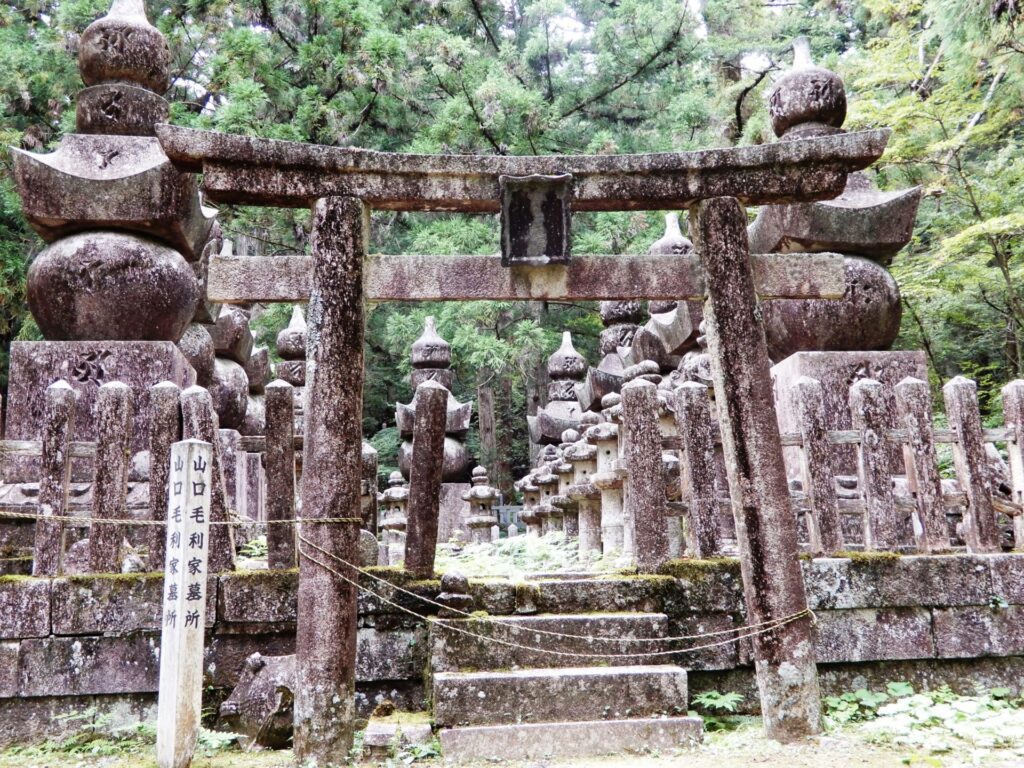
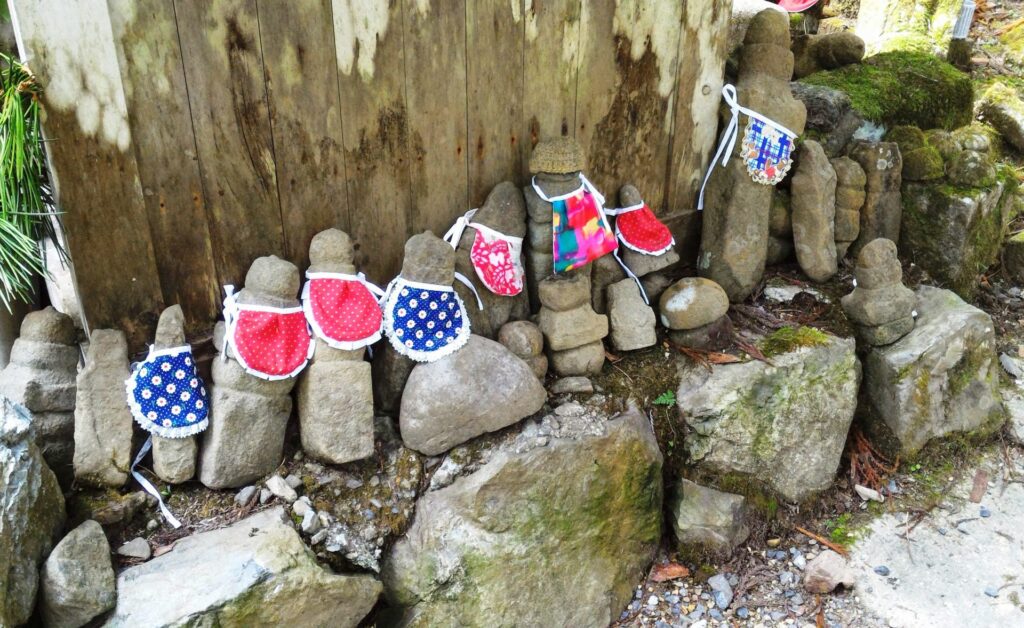
The tombstones of samurai famous people and other historical figures are noticed there, but also direct your gaze towards small tombstones of the working class. Discreetly placed, you will be able to pass by without noticing. What is unique about Mount Koya is its generous spirit which welcomes all without distinction of rivalry, social class, gender or religion.
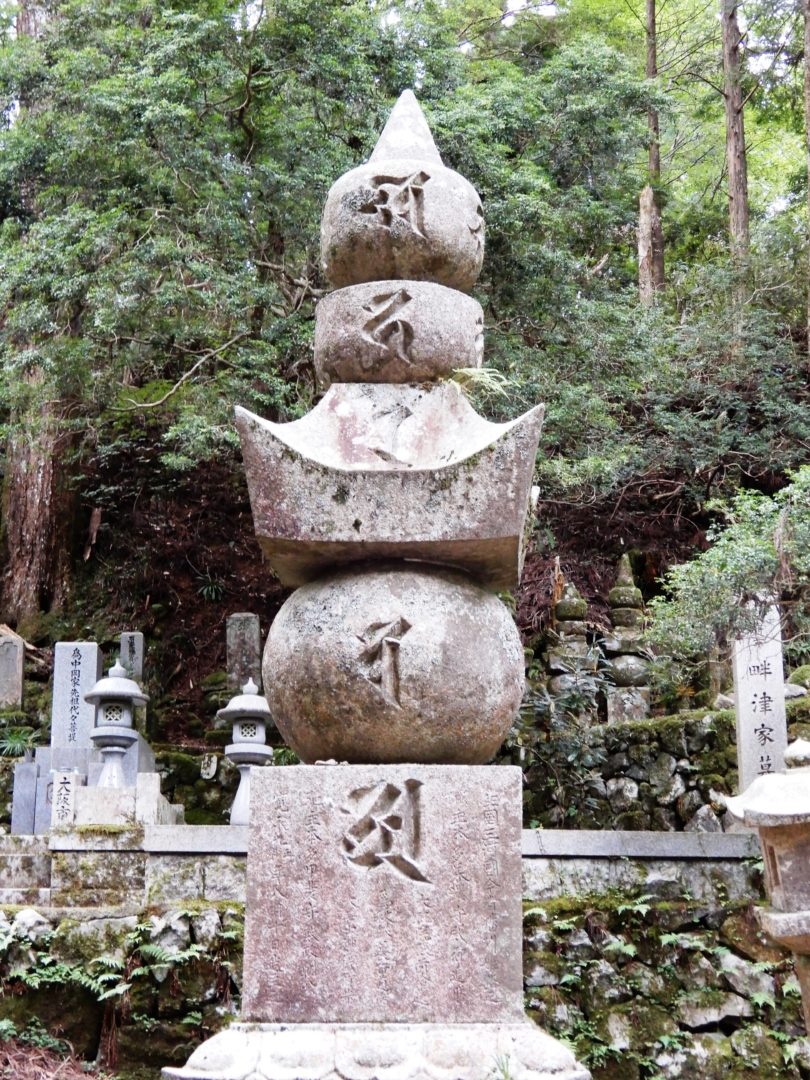
The five-story tombstones found at Okuno-in are generally called gorinto. The shapes and letters engraved in Sanskrit relate to the five elements that make up the universe. From bottom to top, the square represents earth, the ball water, the triangle fire, the half-moon wind and the lotus leaf sky. The largest tombstone belonging to the mother of shogun Tokugawa Iemitsu is 6.6 meters high.
You will also notice small stone statues wearing bibs or hats. These are statues of the bodhisattva jizo. Like the jizo is the most familiar Buddha to us, he is worshiped not only in temples but also on street corners. In Buddhism, the jizo works wishing to help people against suffering and misfortune. According to popular belief, the jizo watches over children and protects the souls of deceased children in the afterlife. This is why he keeps the facial features of a child. I will show you the jizo interesting to see while walking around.
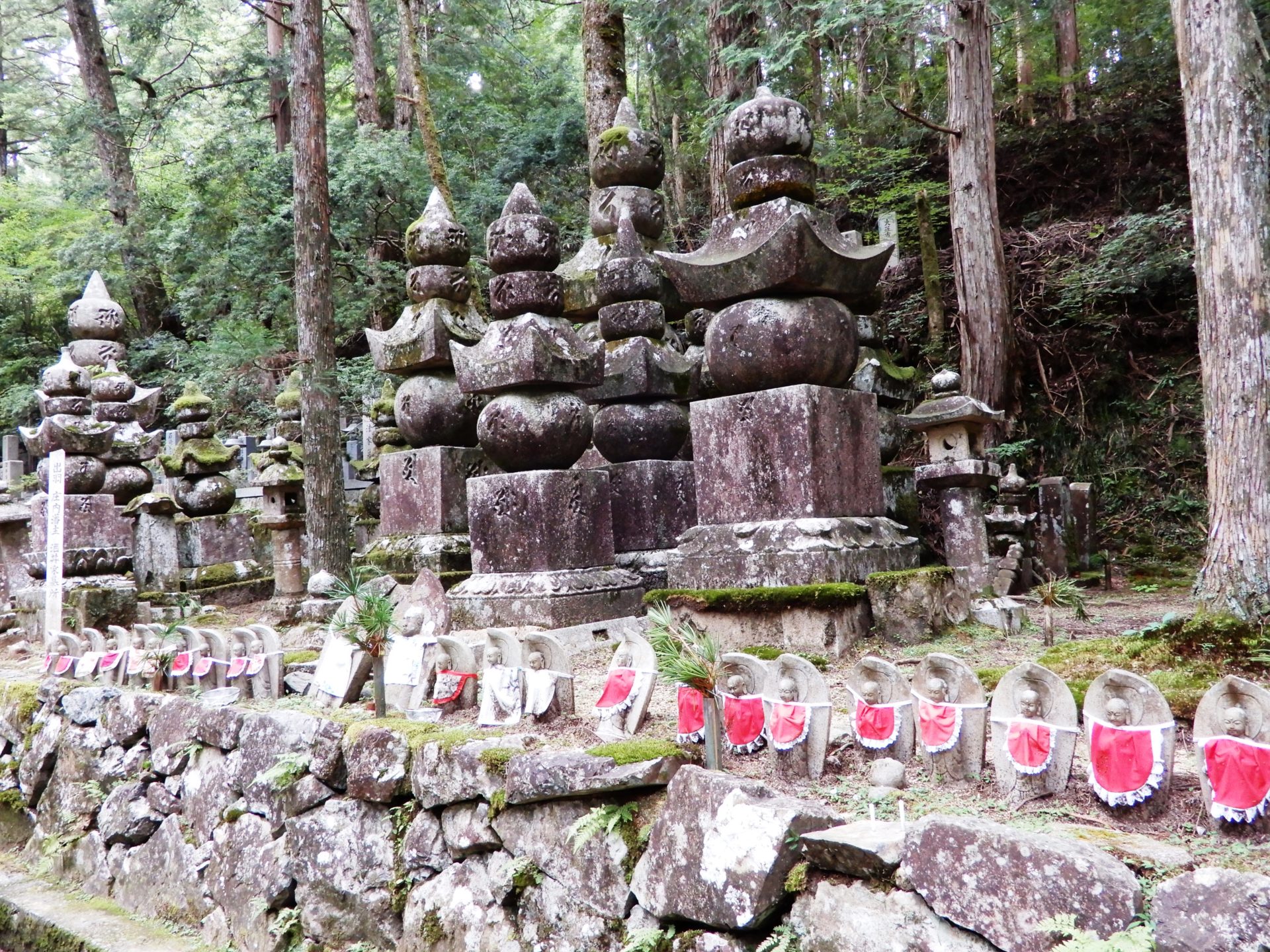
The jizo kazutori who binds himself with the god of hell, enma. It counts our visit to Okuno-in. The more one visits it, the more merit one can accumulate. This jizo can therefore alleviate our sin in this world and lead us to paradise.
The jizo kesho. it is very noticed because of its made-up face. According to a legend, women will be more beautiful with makeup. Wanting beauty, wealth… These desires are considered passions which must be tamed in general Buddhism, but they will be fulfilled for the moment in esoteric Buddhism.
The jizo nakayoshi who press against each other. Their gentle faces create a relaxed atmosphere.
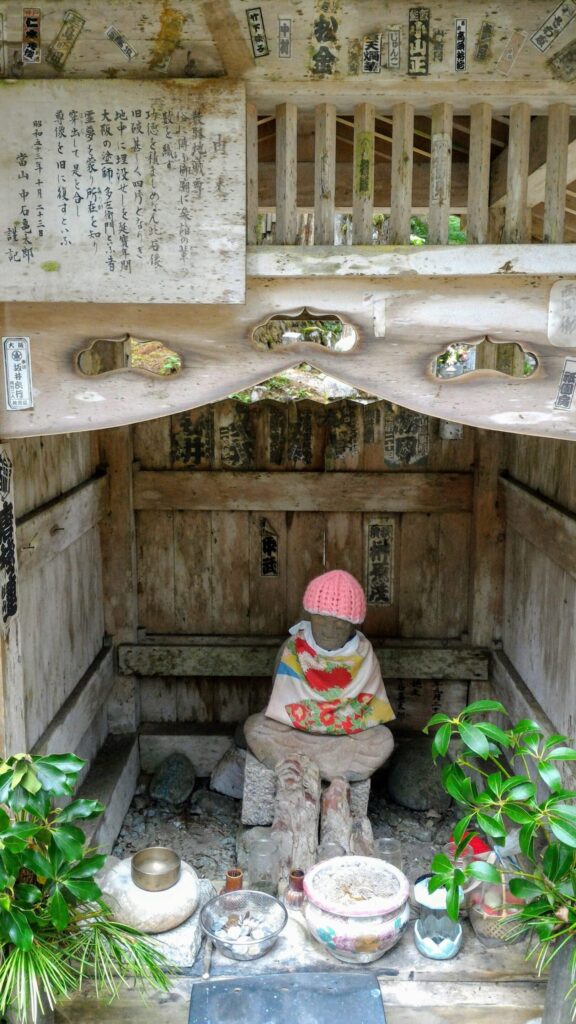
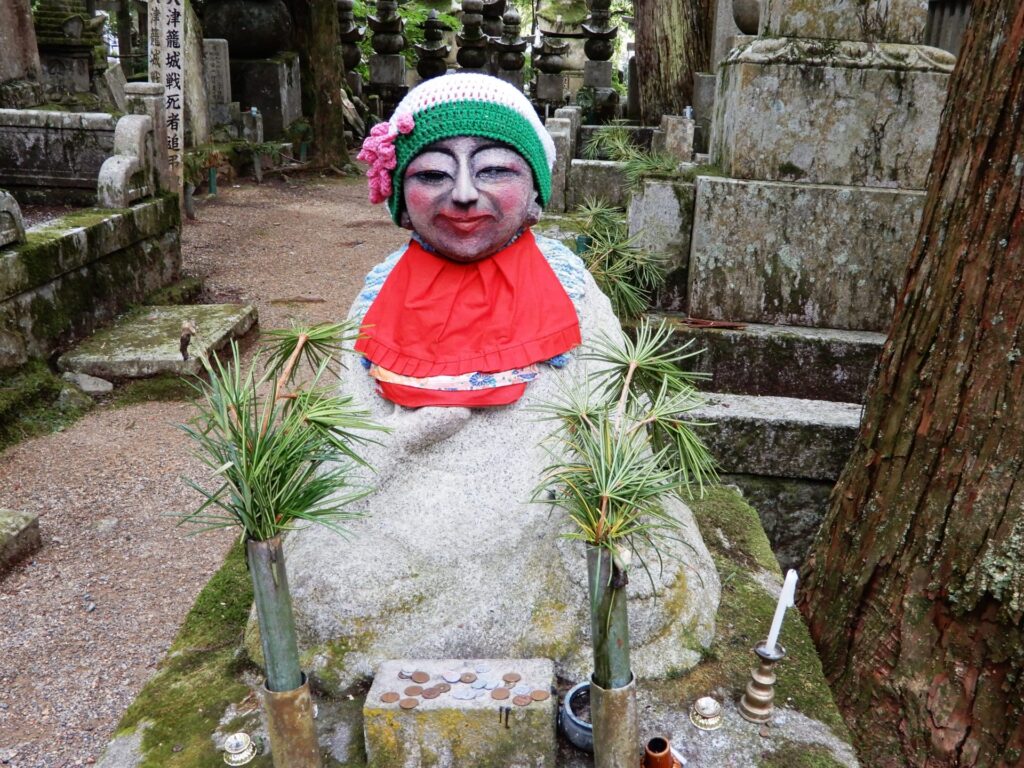
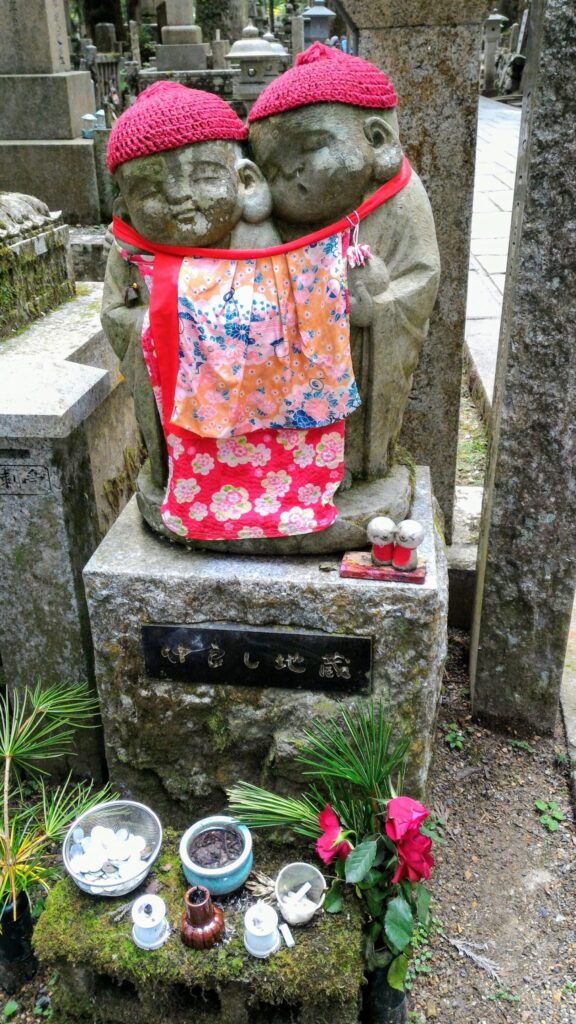
Near the Gobyobashi Bridge which crosses the Tama River, 15 bronze Buddhist statues are lined up. There are others other than those of jizo, but all the statues are referred to under the generic name of jizo mizumuke. Visitors to Okuno-in purchase Buddhist tablets for the deceased at the offering hall, Gokusho, and pour water three times on the tablets placed at the foot of these statues to soothe the souls of the deceased.
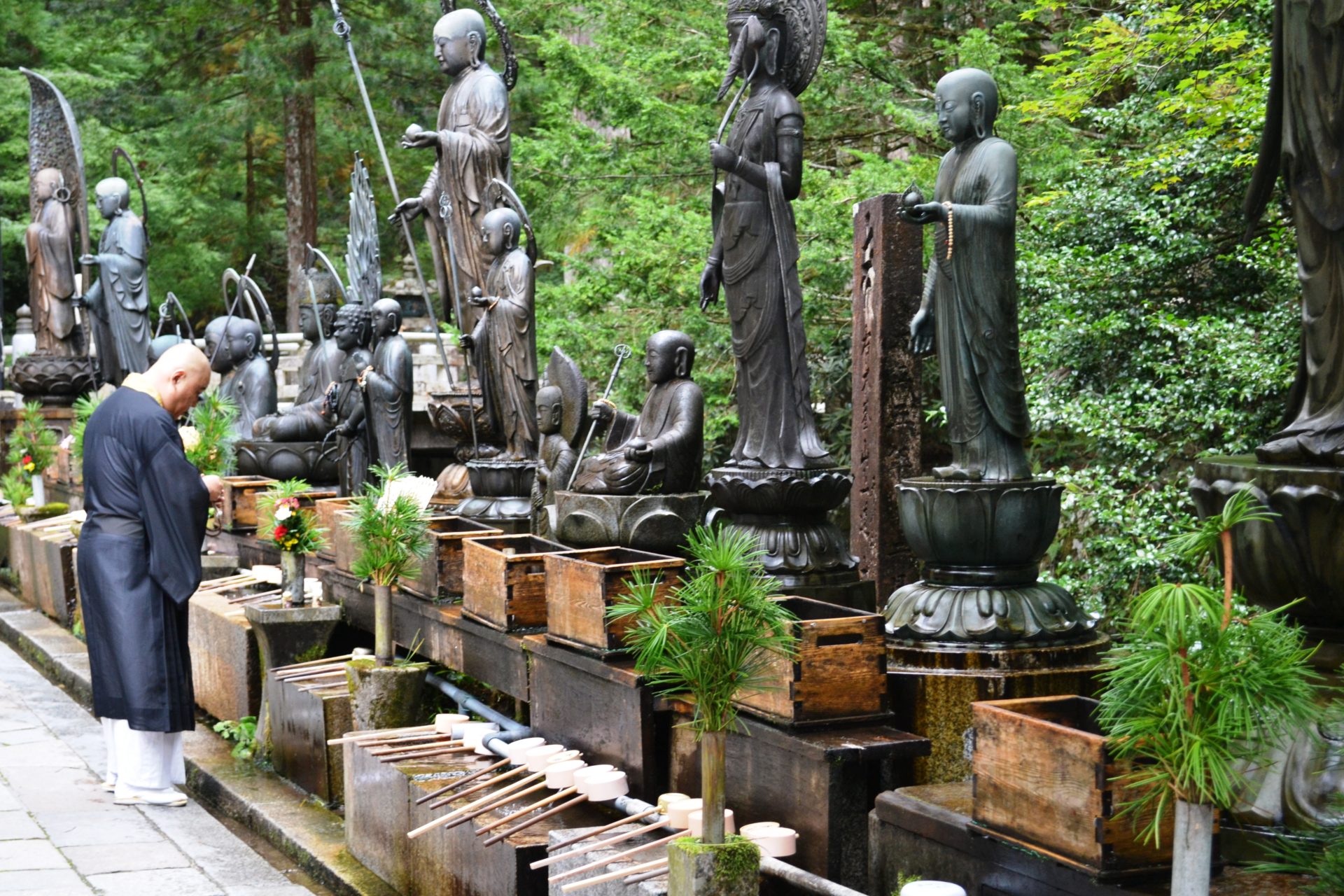
When one crosses the Gobyobashi Bridge which leads to the Kukai Mausoleum, one enters the most sacred space of Mount Koya. Beyond this bridge, taking photos, drinking, eating or smoking is prohibited. Remember to bow your head and fold your hands in prayer before crossing it. The Kukai mausoleum is at the far end, behind the prayer chapel illuminated by more than 10,000 lanterns donated by the faithful. By the way, what kind of person was Kukai who is so respected even today?
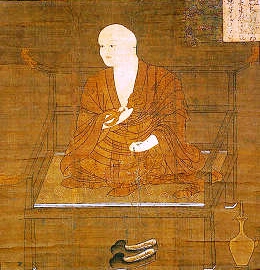
In a word, Kukai was a genius. He was born into a local magistrate’s family on the island of Shikoku in 774. Interested in Buddhism, he left for China at the age of 30 and acquired the mysteries of esoteric Buddhism in 2 years. shingon difficult to understand. (Normally, it took 20 years to acquire them. ) He returned to Japan to spread what he learned in China. At the time, this was very rare. If Kukai had not been able to return to Japan, Mount Koya as a sacred site of esoteric Buddhism shingon would not have existed. In 816 he was permitted to install a sacred site of esoteric Buddhism shingon on Mount Koya. He died in 835, but it is said that he is still alive and is in meditation at Mount Koya praying for the peace and happiness of the people. Meals are brought by the monks to his mausoleum twice a day. This tradition testifies to the people’s deep devotion to Kukai.
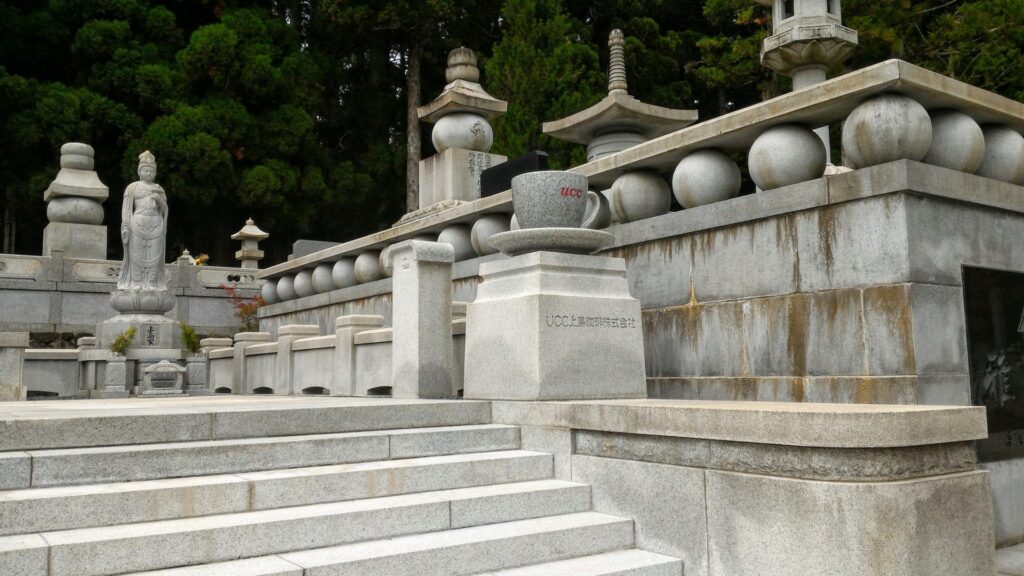
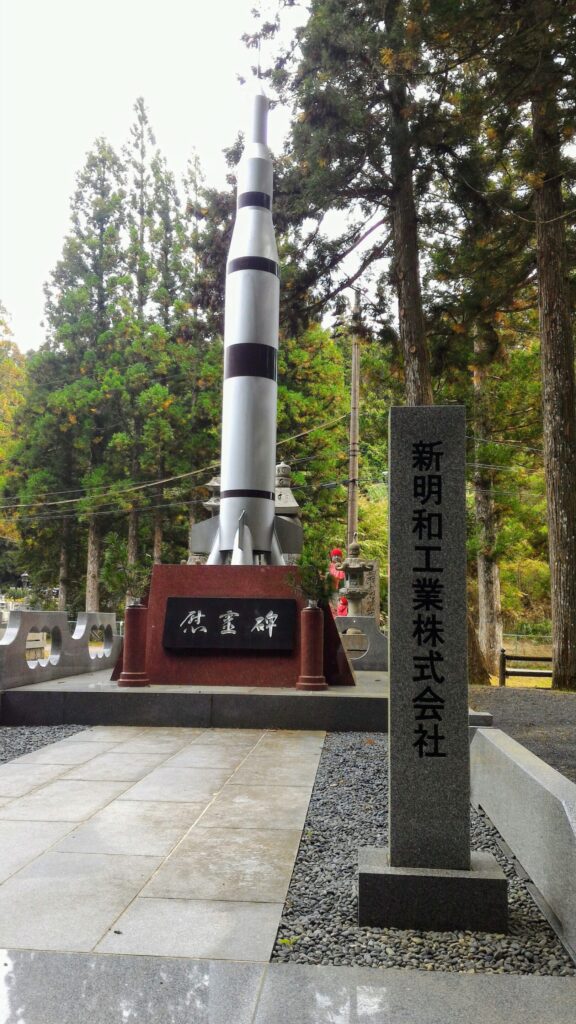
If you take a circuitous route back from Kukai Mausoleum, you will arrive at the contemporary cemetery and find a wide variety of original tombstones. These are monuments established by Japanese companies to pray for the repose of the souls of employees. In Japan, the tradition was that a man had total loyalty to the company where he worked. I think these monuments demonstrate the companies’ sincere appreciation for their employees.
Danjo Garan
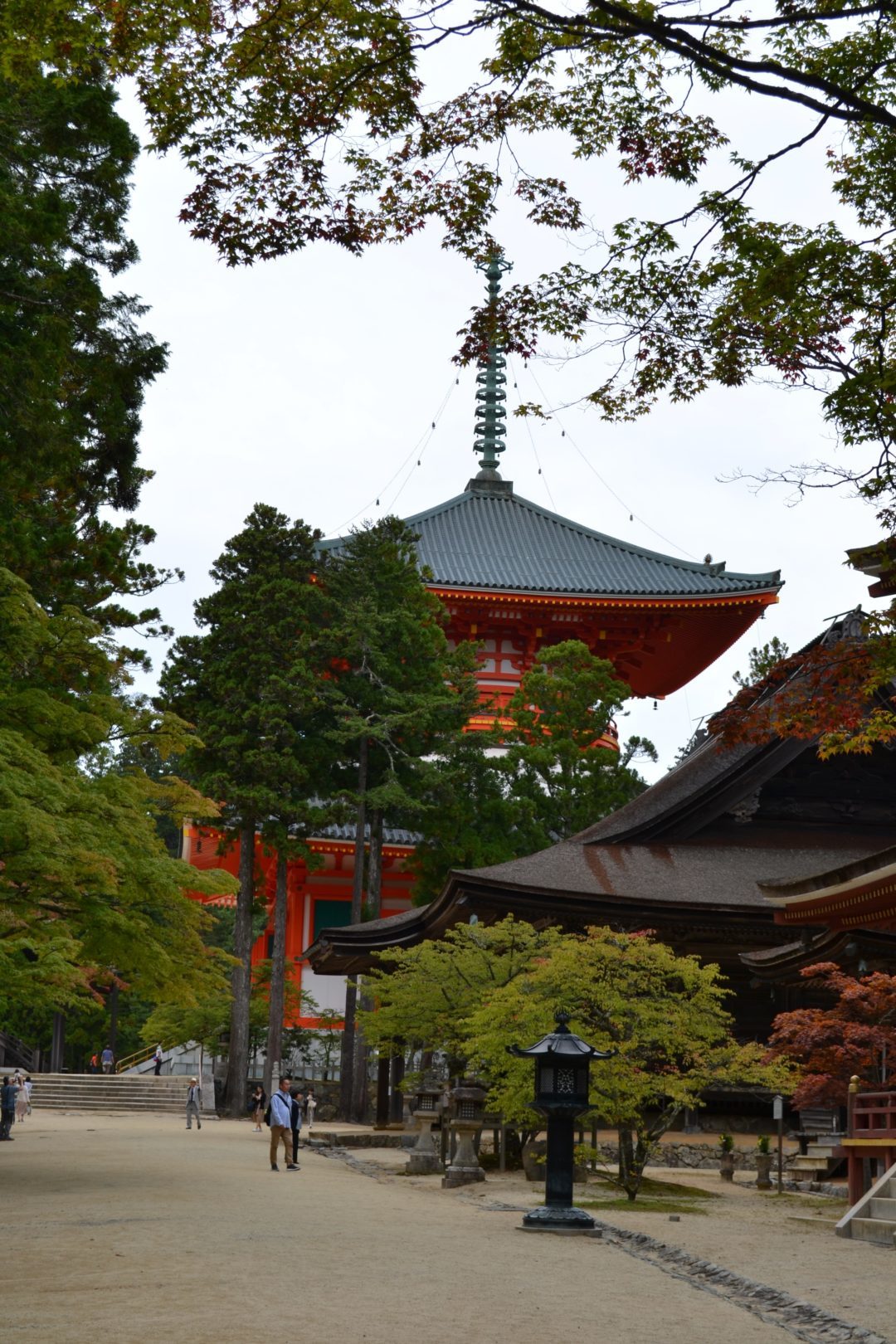
Danjo Garan, a place dedicated to the spiritual exercises of esoteric Buddhism shingon, extends to the west of Mount Koya. It is a complex which brings together many religious buildings including a large vermilion pagoda. It was the first that Kukai approached to build during the founding of Mount Koya.
By the way, what is esoteric Buddhism shingon?
The shingon means the “true word” to establish links directly with the Buddha. The main Buddha of esoteric Buddhism shingon is the dainichi nyorai. He is the cosmic Buddha who enlightens all with his wisdom and mercy. According to school teaching shingon, all other Buddhas are the incarnations of dainichi nyorai. Unlike other Buddhist schools, esoteric Buddhism shingon aims to achieve the state of fusion with the dainichi nyorai in this world through various exercises for enlightenment, satori.
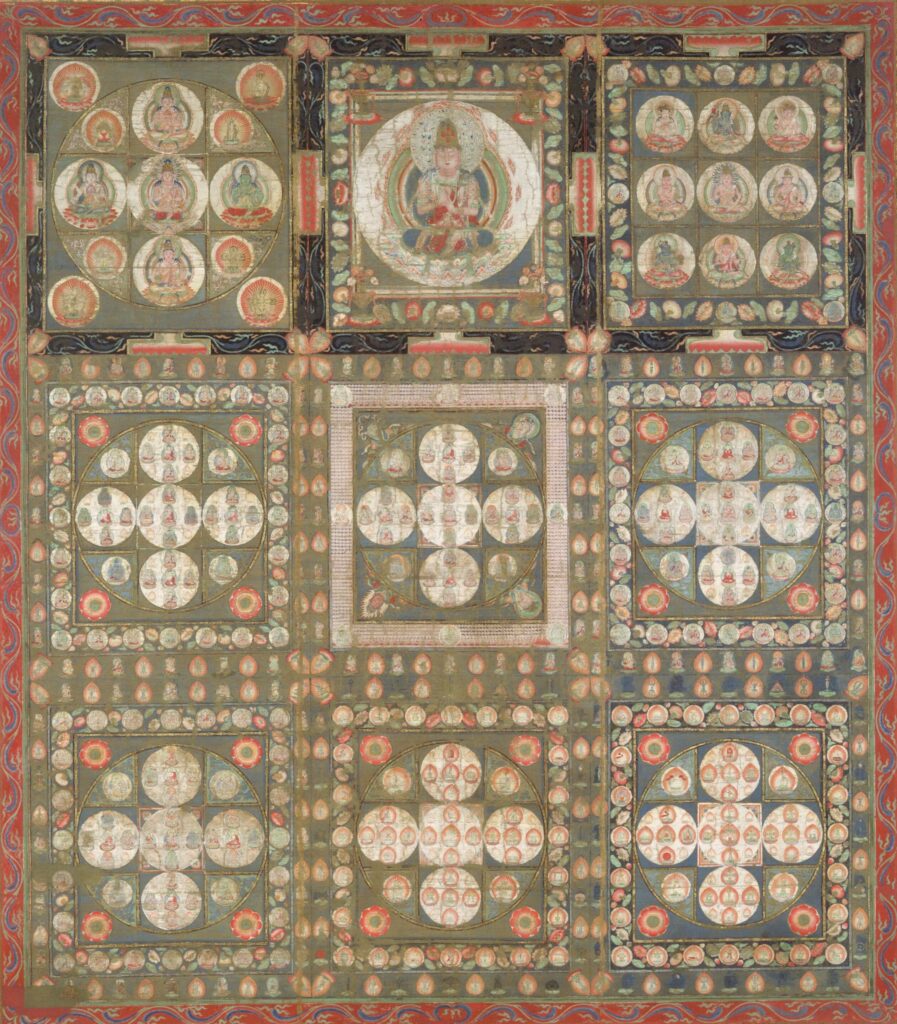
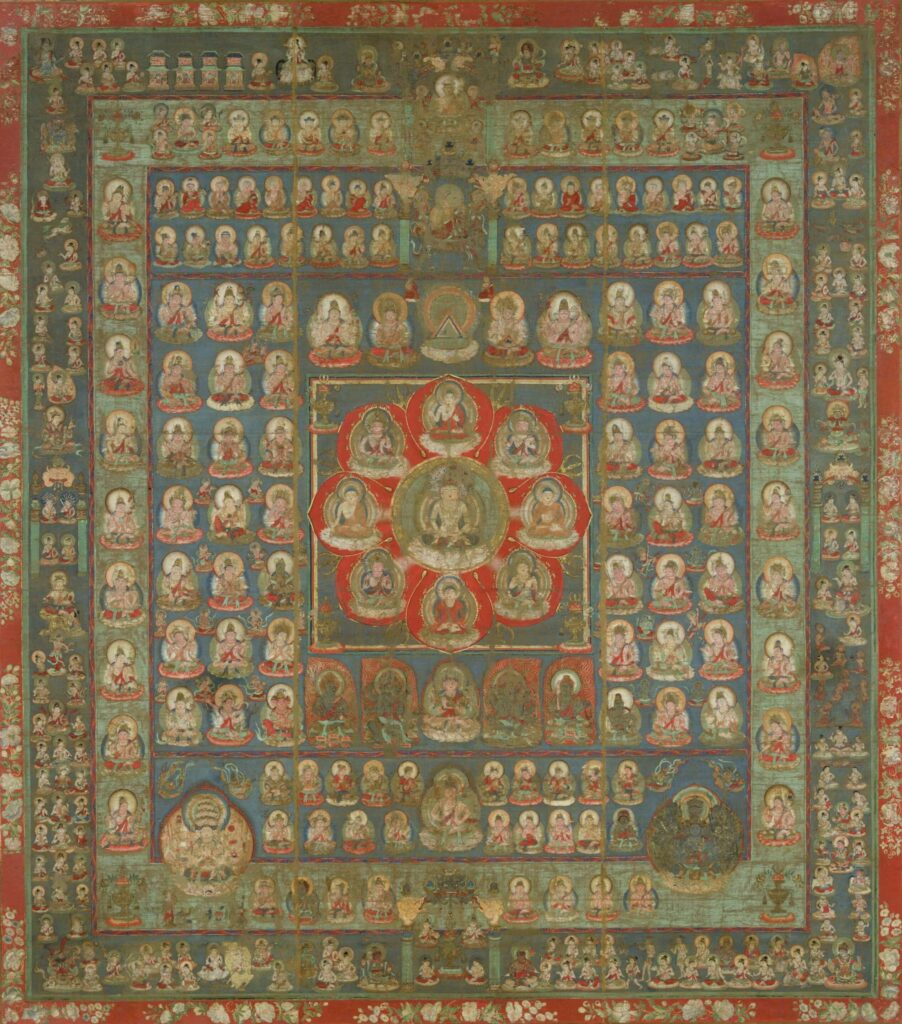
You will notice the geometric pattern painting hanging on Mount Koya. This is the mandala, reduced image of esoteric Buddhism. Many Buddhas are drawn there in round or square divisions. The mandala on the left is that of the diamond kingdom, kongokai-mandala. It represents the wisdom of dainichi nyorai which is neither damaged nor shaken. The mandala on the right is that of the realm of the matrix, taizokai-mandala. It represents the mercy of dainichi nyorai drawn in the center. All of these two mandalas is called the mandala of the two kingdoms, ryokai-mandala.
At Danjo Garan, a large vermilion pagoda called the Konpon Daito is highlighted. Its interior with varied and bright colors will impress you. A huge mandala three-dimensional is formed there with a large statue of the dainichi nyorai of the kingdom of the womb escorted by four statues of the Buddha of the diamond kingdom and surrounded by sixteen columns where the deities of compassion are painted, kannon.
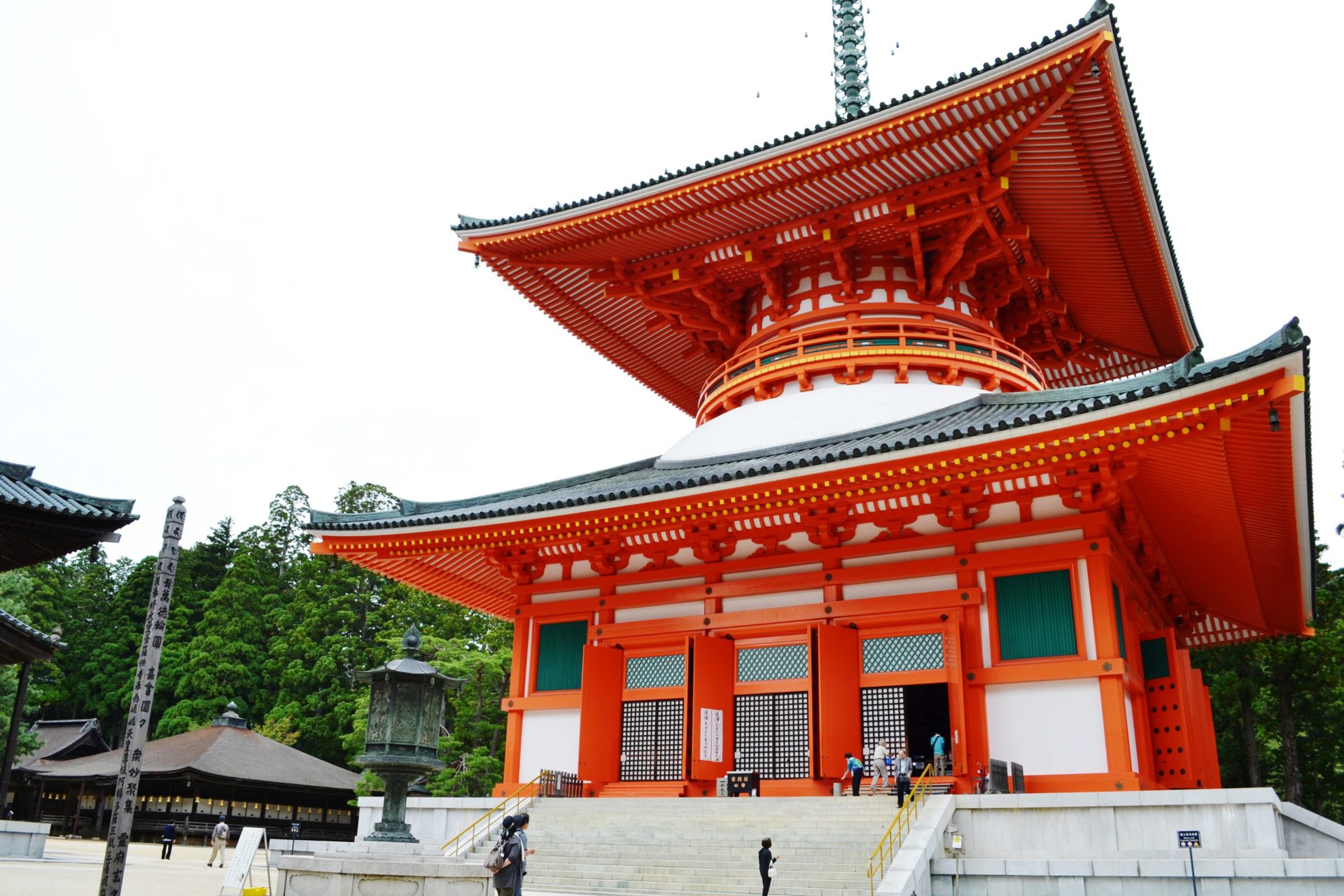
- The entrance ticket price for Konpon Daito is 500 yen.
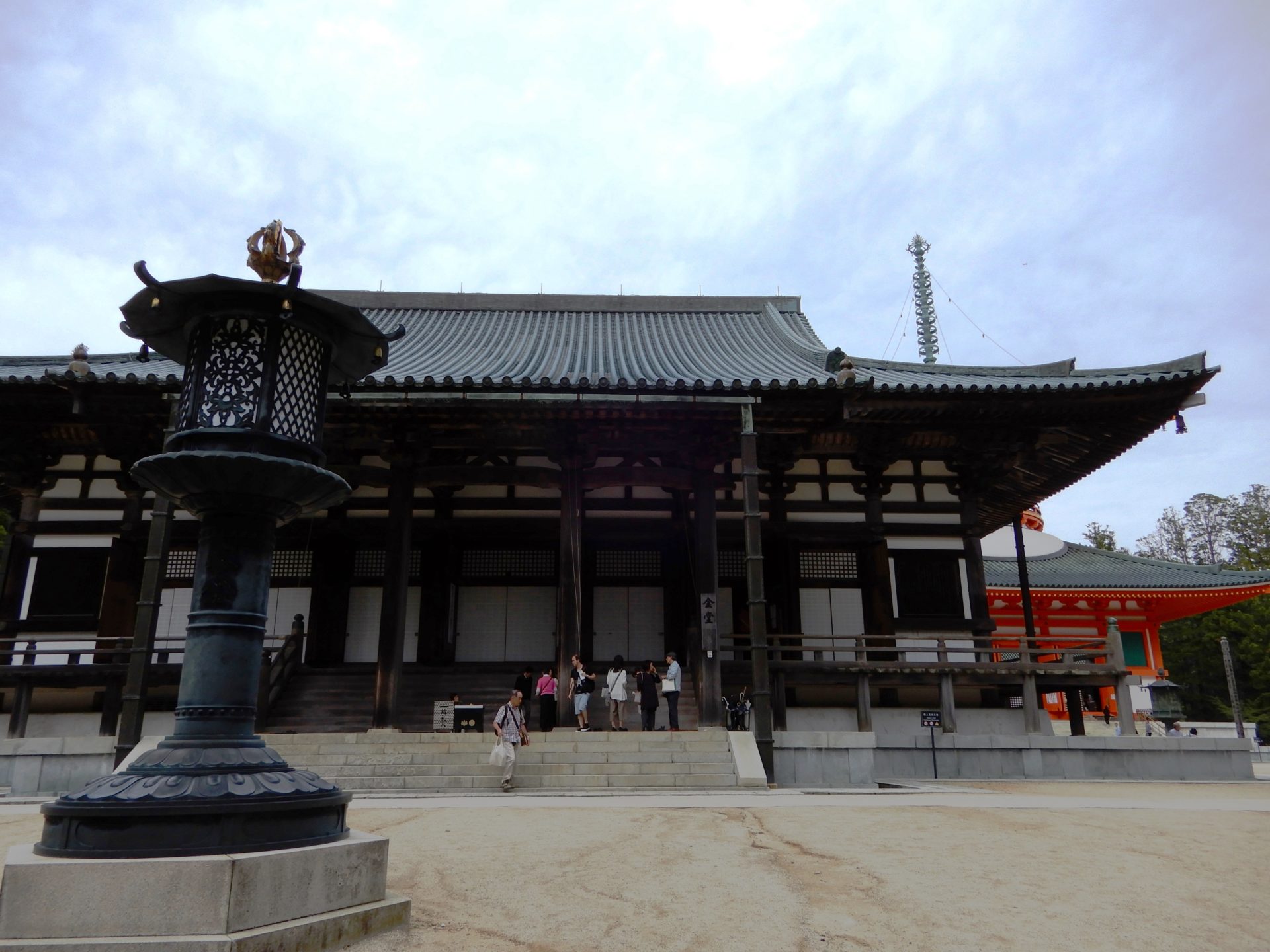
Kon-do serves as the main pavilion of Mount Koya where major religious ceremonies take place. It has been destroyed by fire six times in its history. The current pavilion is the 7th reconstruction, as it occupies such an important place in Mount Koya.
- The Kon-do entrance ticket price is 500 yen.
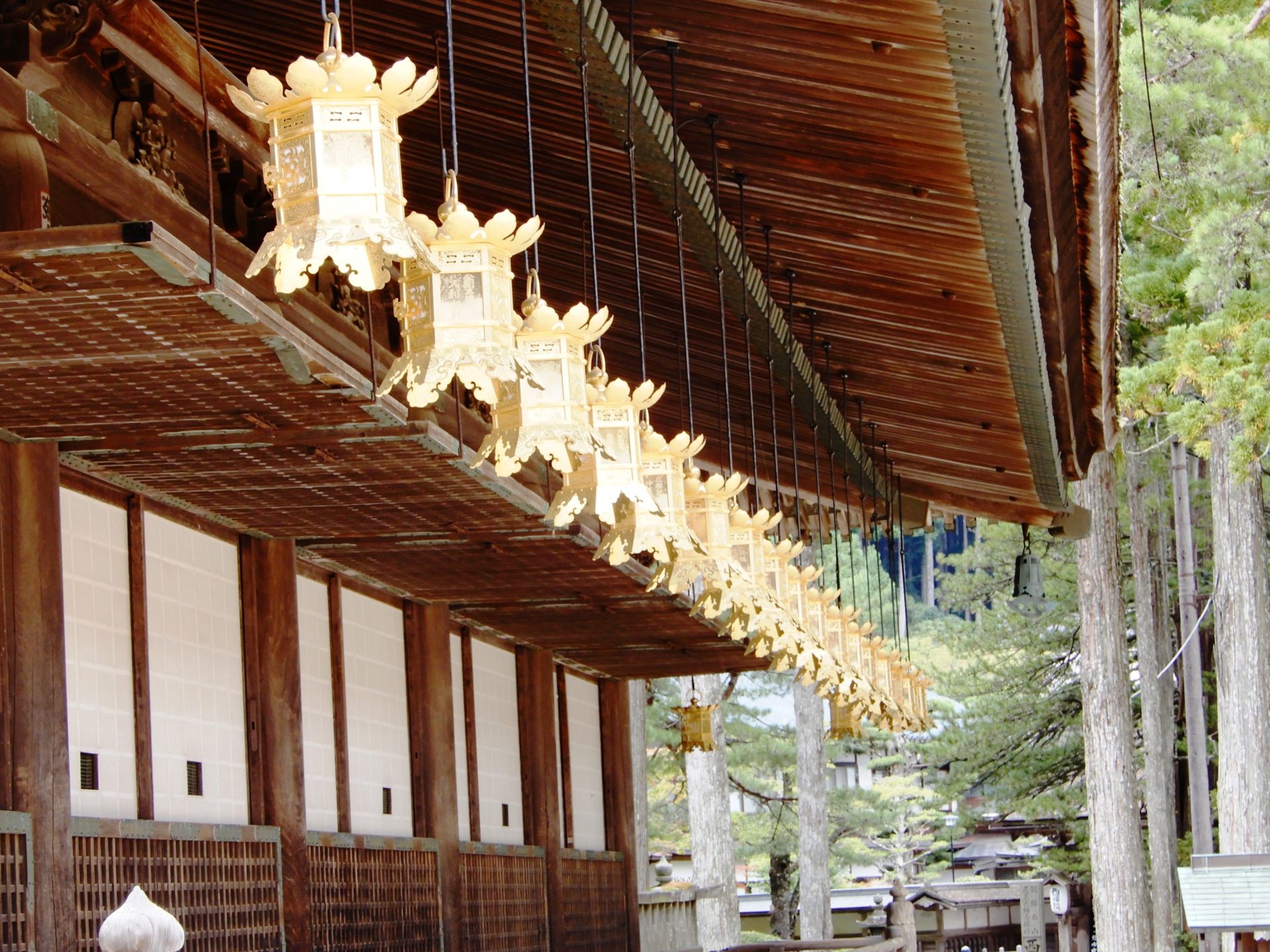
The Mie-do, an elegant pavilion with hanging lanterns, was originally Kukai’s private Buddha hall. It houses his portrait. In Danjo Garan, most buildings were destroyed by fire several times. Today there is the fire protection system and do you know what it is?
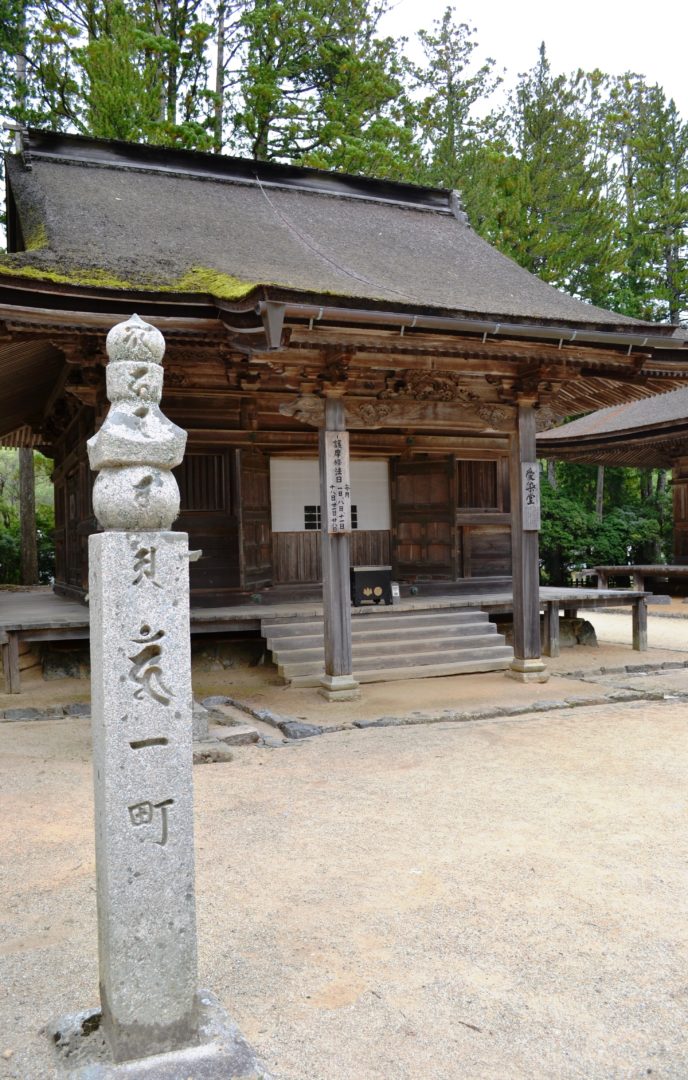
At Mount Koya, stone steles stand out. These are markers called choishi erected on the 24-kilometer-long pilgrimage route leading to Mount Koya. They are about a hundred meters apart. There are 180 from Jison-in, a temple located at the foot of Mount Koya in Danjo Garan, and 36 from Danjo Garan in Okuno-in. The number 180 corresponds to the number of Buddhas in the matrix realm and the number 36 corresponds to the number of Buddhas in the diamond realm. In the past, pilgrims walked this pilgrimage route, offering prayers every time. choishi. The first choishi of the Diamond Kingdom is located in front of the Aizen-do Pavilion, one of the buildings making up Danjo Garan. Can you find it?
Kongobu-ji Temple
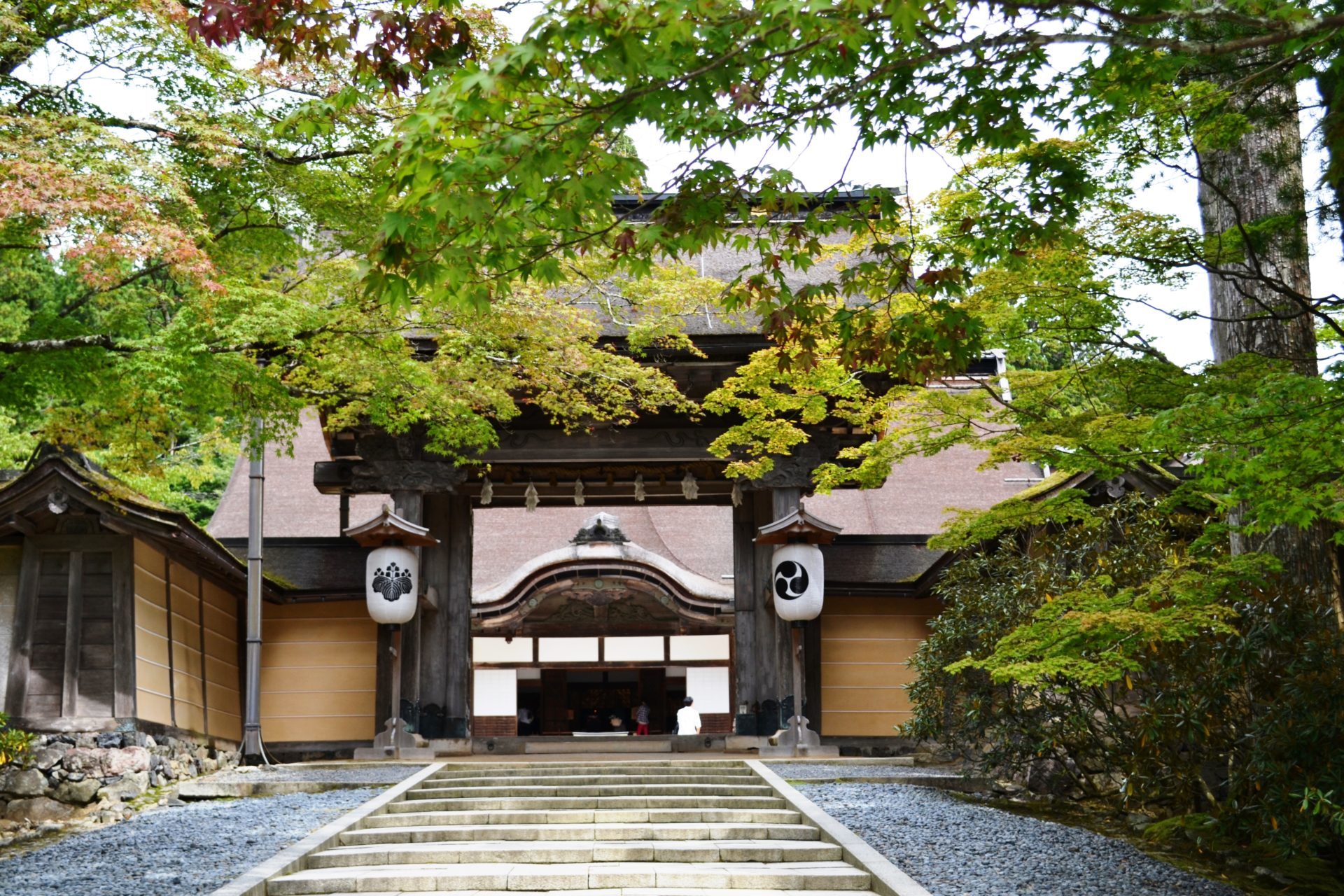
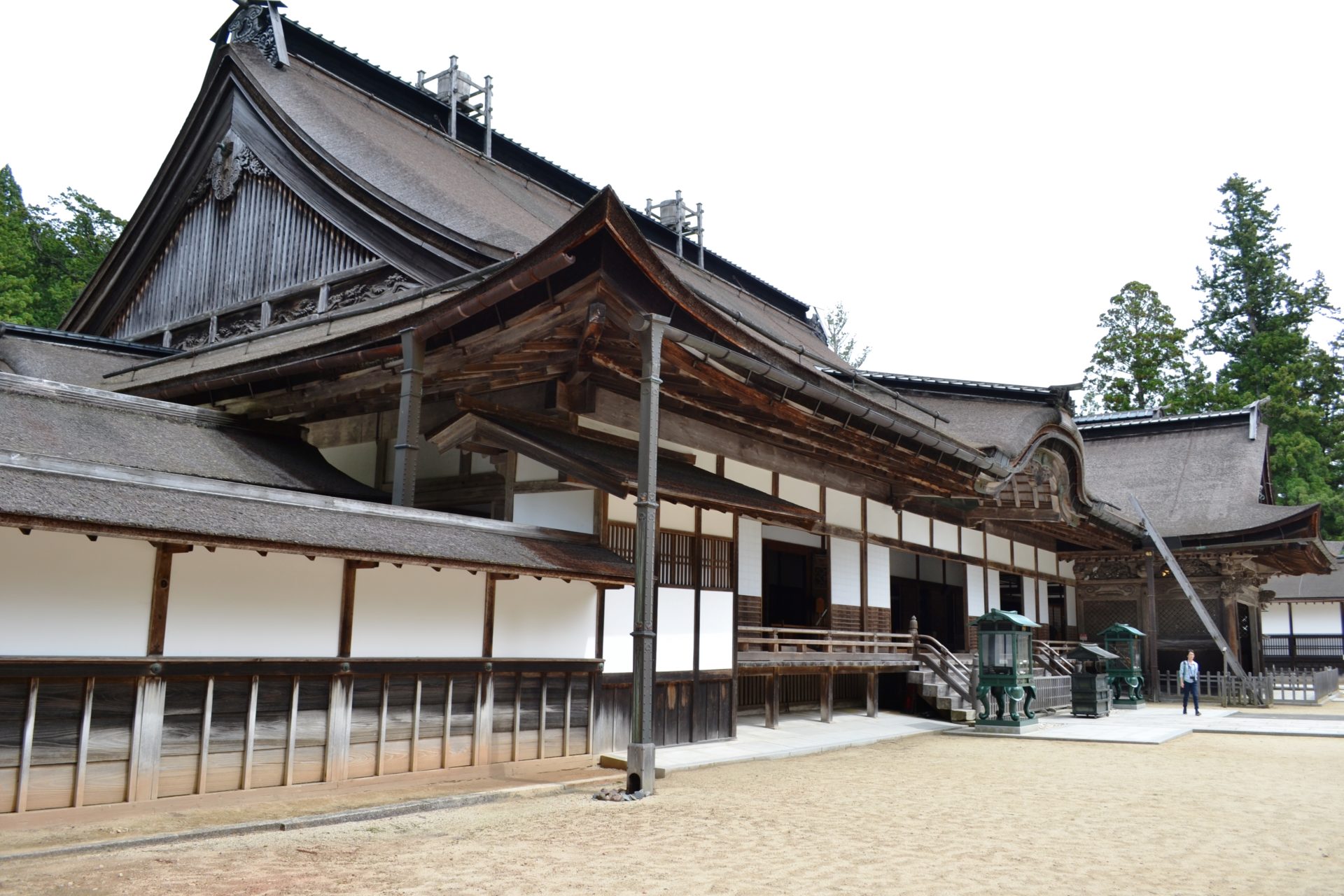
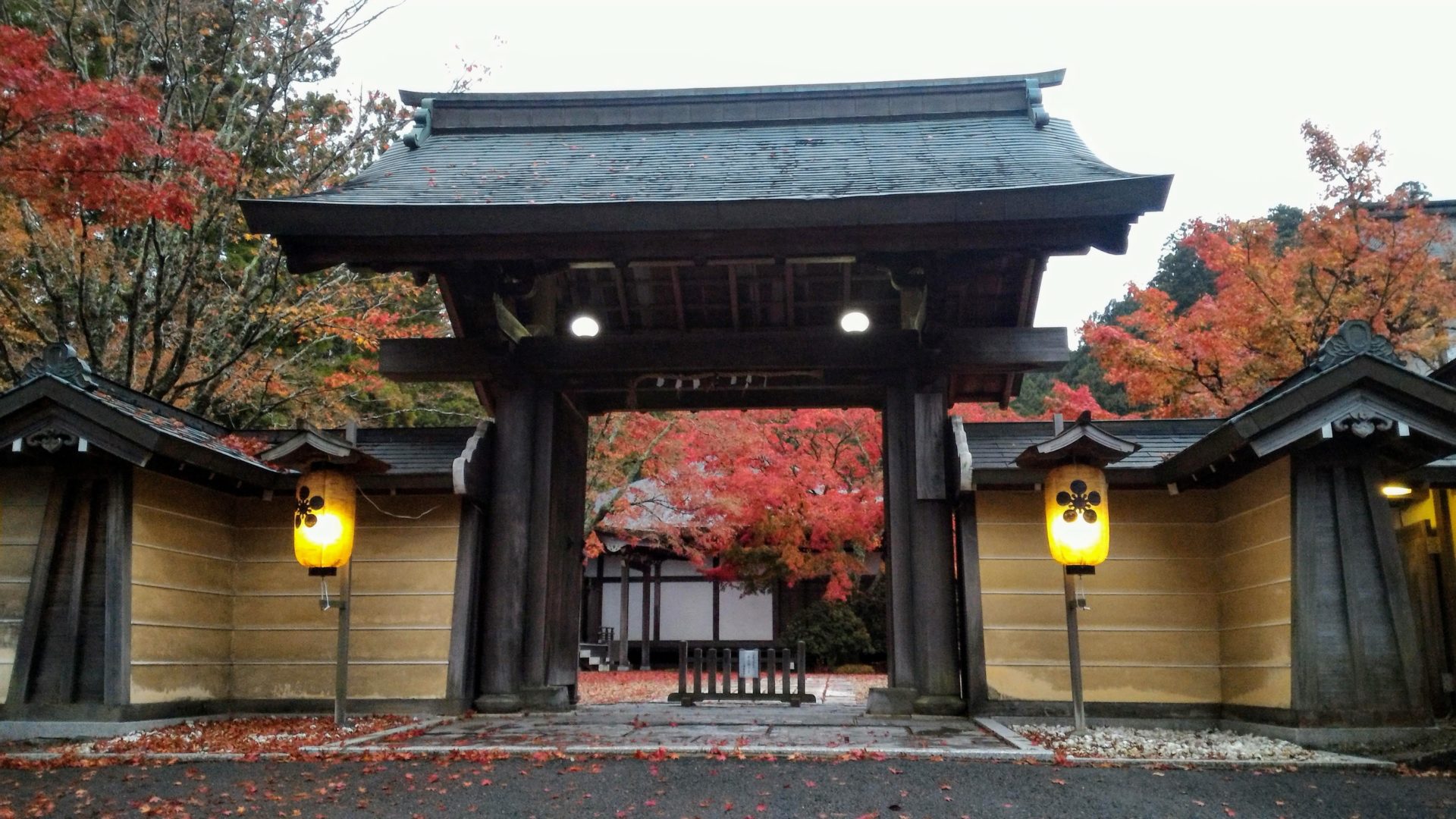
Located near Danjo Garan, Kongobu-ji Temple serves as the main temple of Mount Koya. If you don’t have enough time to visit Mount Koya, I advise you to visit it. He has two coats of arms. You can confirm them by the door lanterns. The coat of arms on the left has a paulownia motif and that on the right has an antique ornamental motif called magatama.
What can we see on the roof covered with Japanese cypress bark of this main building? These are barrels to collect rainwater, but for what reason?
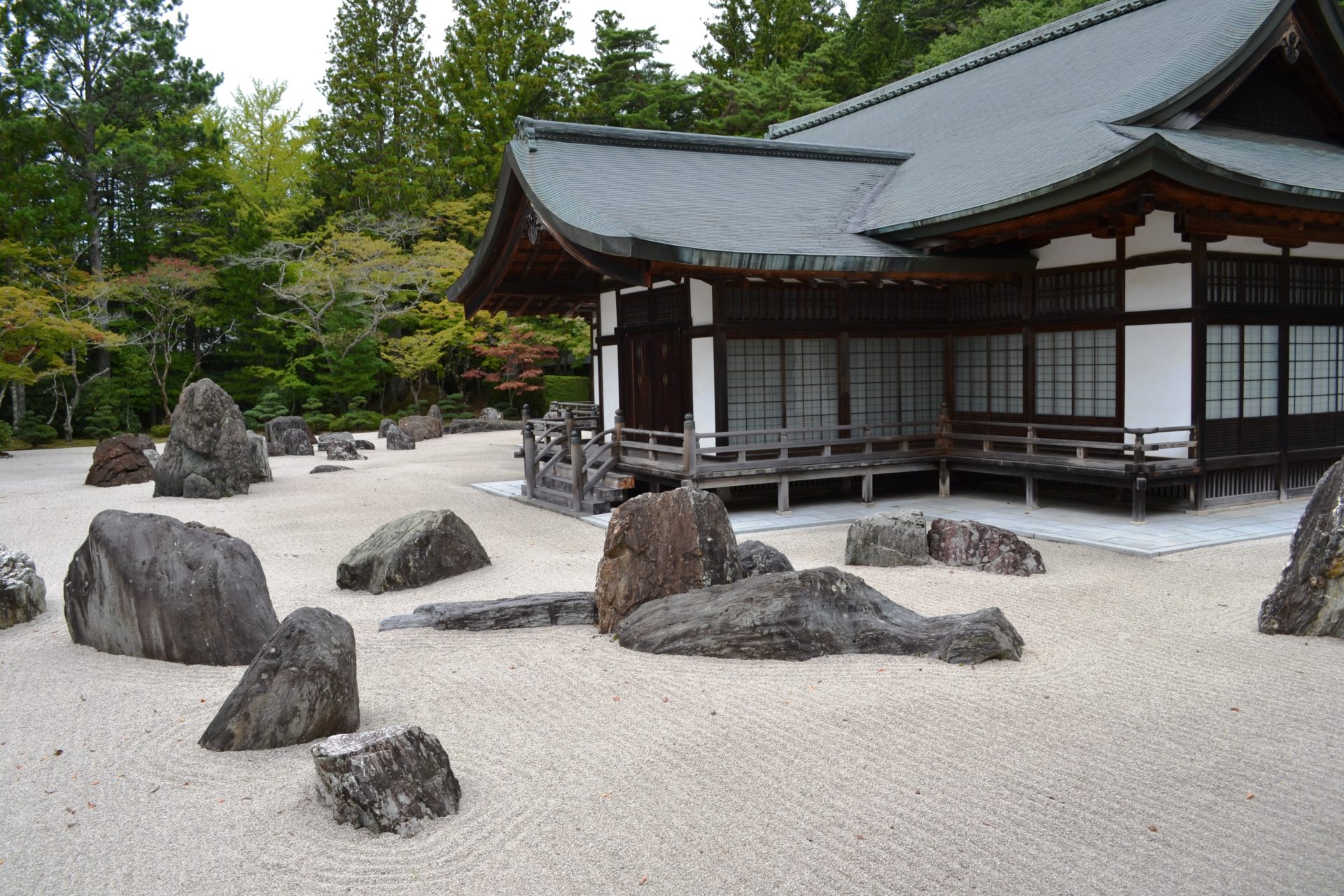
Kongobu-ji Temple is home to the largest stone garden in the country. It depicts a pair of dragons standing face to face in the sea of clouds. The stone garden evokes the temple Zen. It is astonishing that the largest stone garden is found at Mount Koya, a sacred site of esoteric Buddhism shingon. Granites from Shikoku Island, Kukai’s native country, are used there. I think this garden was created as a tribute to Kukai.
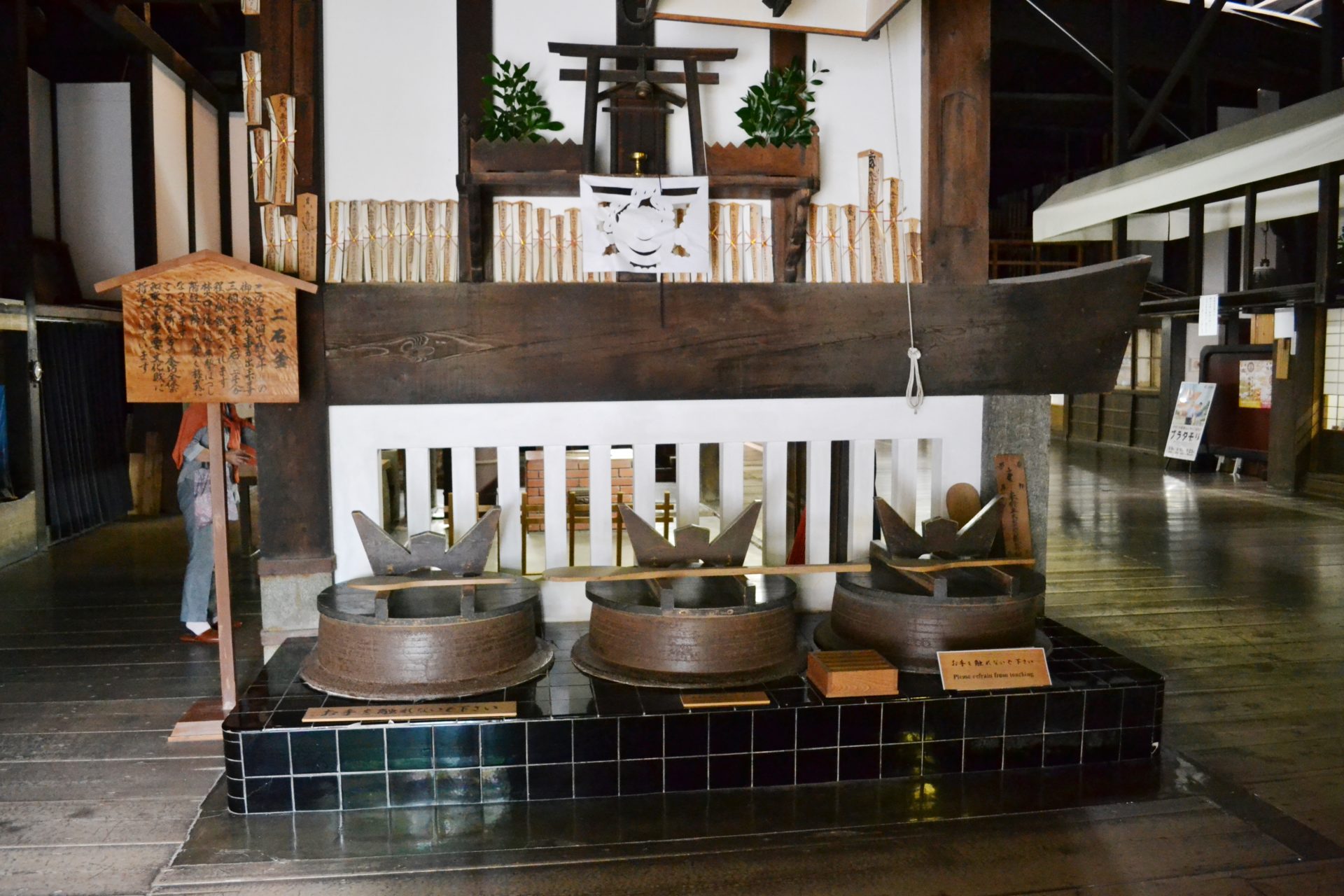
At the end of the temple tour, you will see its huge kitchen where meals for many monks were prepared. Don’t miss seeing three large cauldrons for cooking rice that fed around 2,000 people. Below the altar of the kitchen deity, a cut sheet of paper hangs. This paper decoration replaces the shimenawa, sacred rope made of twists of rice straw. This is the ancient tradition practiced at Mount Koya where the land is not suitable for rice growing.
- The Kongobu-ji Temple entrance ticket price is 1,000 yen.
- Map
The Monastic Lodge, Shukubo
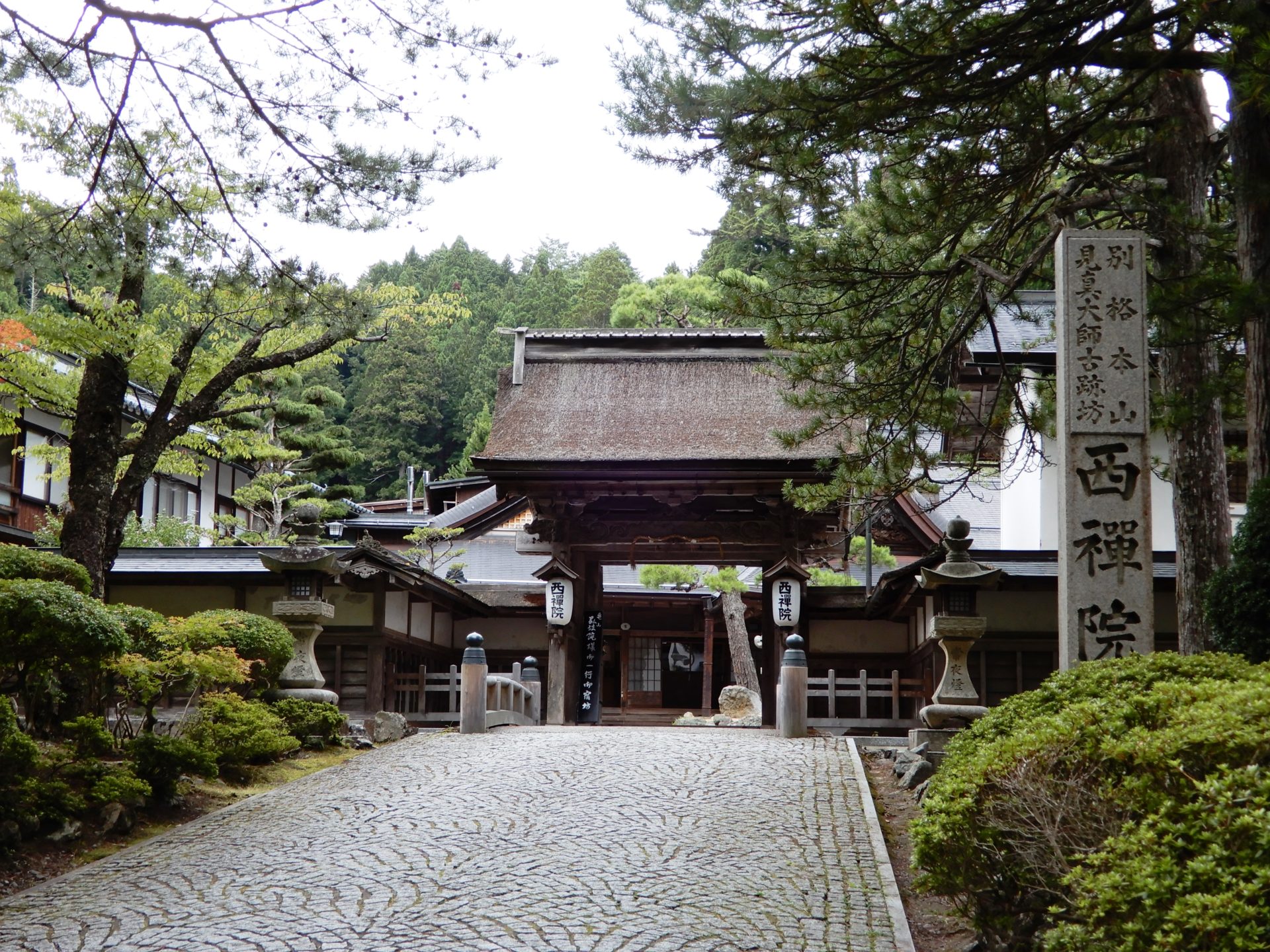
Mount Koya is difficult to access, but it would be a shame to cover it at an accelerated pace after the long journey without spending a night in one of the temples that host the so-called shukubo. Each shukubo is home to its own beautiful gardens. You can also taste Buddhist cuisine or attend morning prayers. Compared to hotels, the facilities and services offered by the shukubo are not careful, and yet this is one of its charms. Staying with the monks will allow you to experience the Buddhist spirit.
Some shukubo served as a family temple of daimyo, feudal lord of yesteryear. You will notice the family crest on the lanterns.
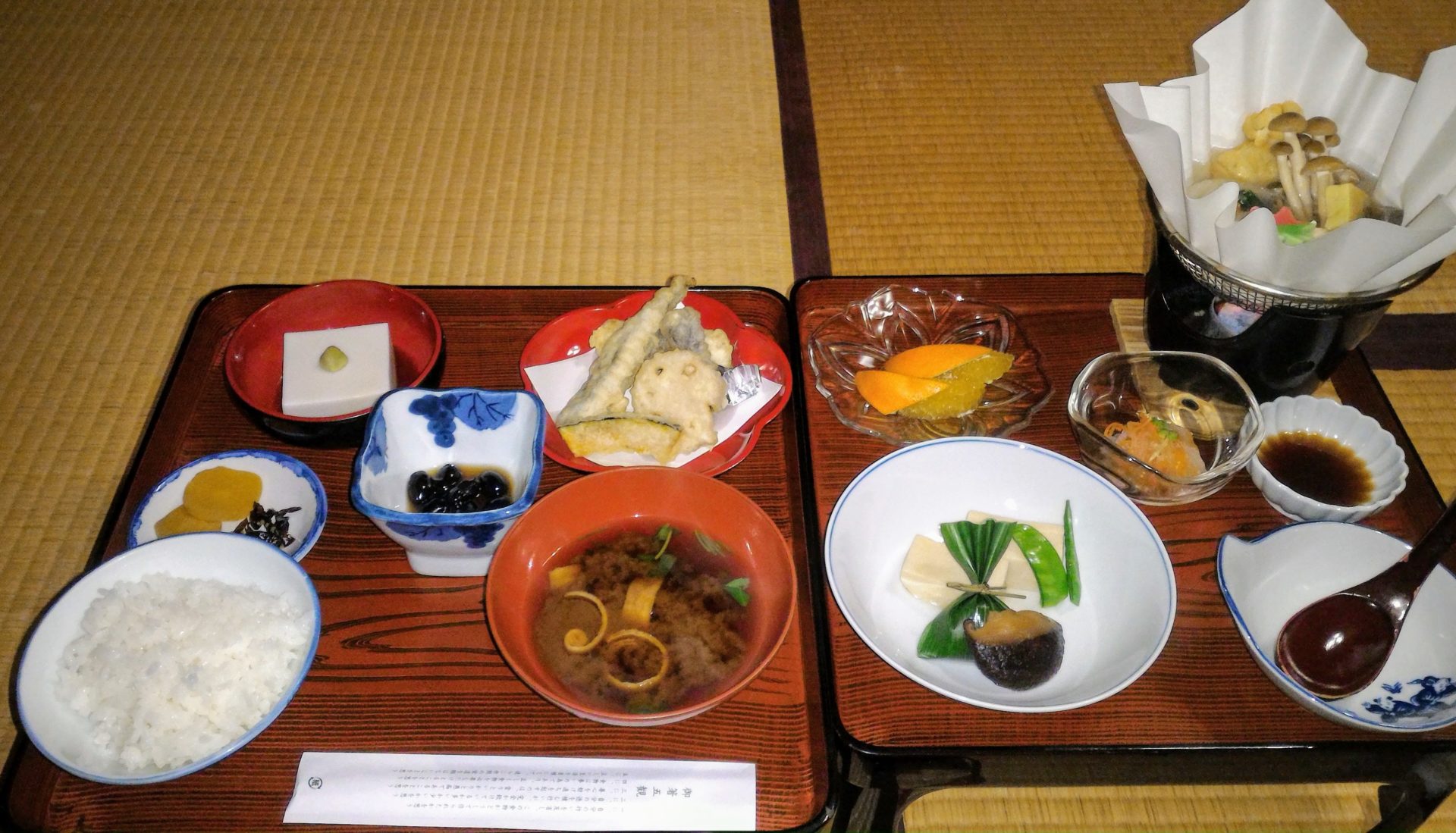
The shojin-ryori, Buddhist cuisine is served in the shukubo. The term shojin means “to chase away distractions and apply oneself to the teaching of the Buddha”. The dishes of shojin-ryori are vegetarian and never contain meat or fish, but you will appreciate their delicate flavor. The natural taste of food is well condensed there. Dishes based ontofu, soy paste are essential. The koya-dofu, tofu frozen and dried is one of the specialties of Mount Koya. THE goma-dofu which means the tofu sesame in literal translation is also used there. Its shape resembles tofu, but it is the mixture of sesame and root starch kudzu where its velvety texture comes from. A little of wasabi, Japanese horseradish enhances its flavor.
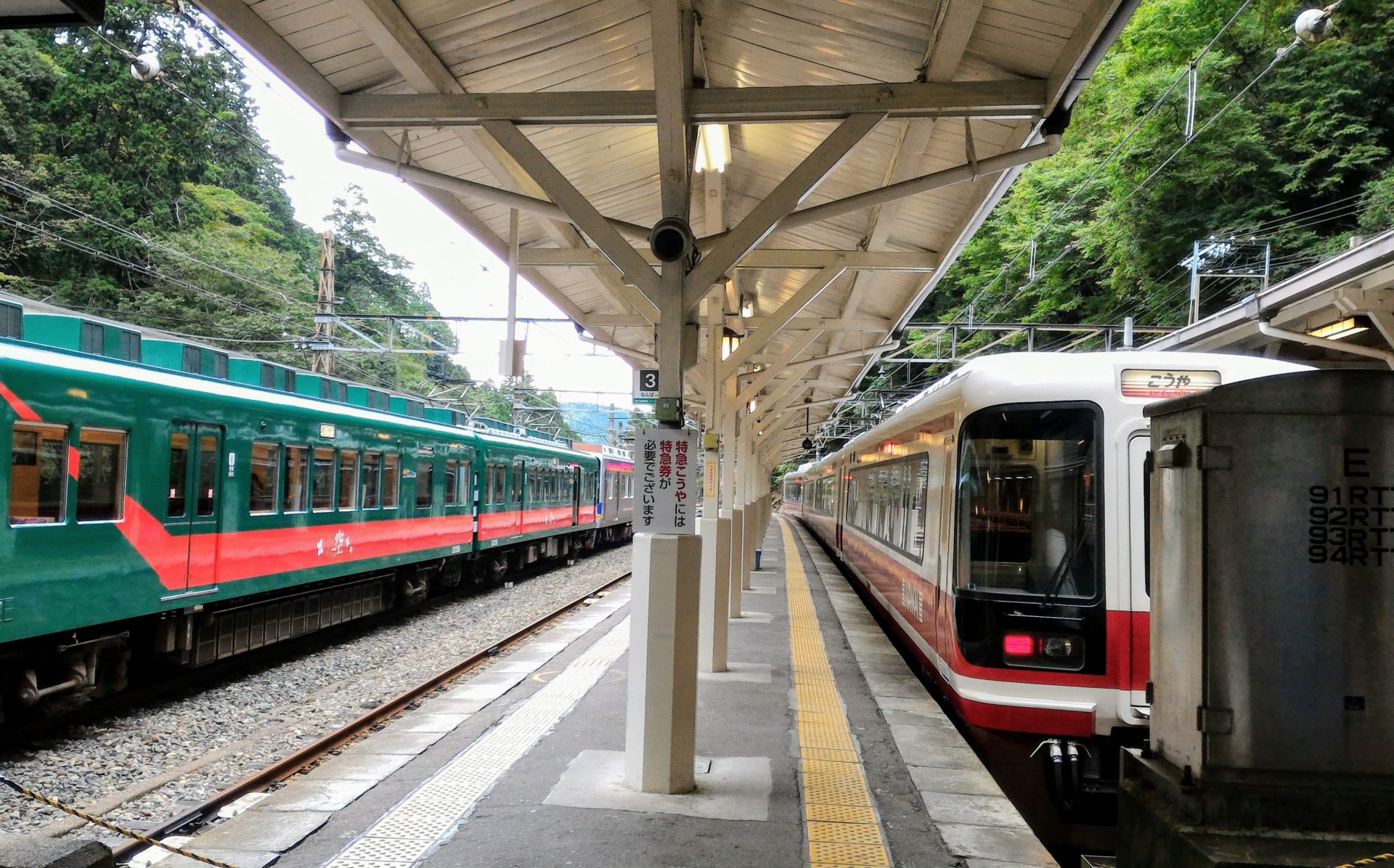
- It takes about 3 hours to go to Mount Koya from JR Kyoto Station. Take the JR Tokaido Line and get off at Osaka Station (30 mins). Change there to the JR circular line called Kanjo-sen and get off at Shin-Imamiya station (15 min). The journey to Shin-Imamiya will be covered by the JR pass if you have it. Shin-Imamiya is the connecting station for the Nankai Line. Buy the advantageous pass, Koyasan World heritage ticket (3,540 yen) at the Nankai line ticket office. Take the Nankai Koya Line and get off at the terminus at Gokurakubashi Station (around 90-100 mins). And then, change the funicular there to go to Koyasan station (5 min). Finally, take the bus to access the interior of Mount Koya (15 min).
If you are departing from Namba in the southern district of Osaka, buy the pass at the ticket office of Nankai Namba Station and take the Nankai Koya Line to Gokurakubashi Station. - Koyasan World heritage ticket includes: round trip ticket between Shin-Imamiya and Koyasan, bus ticket inside Mount Koya and discounts on entrance to Kongobu-ji Temple, Konpon Daito, Danjo Garan Kondo and the museum. You can purchase the one-way limited express train pass with reserved seats (4,090 yen).
- Being direct, the limited express train will be convenient. Most other fast trains only go as far as Hashimoto. You will therefore have to change there to go to Gokurakubashi.